The compile button for hardware.
Describe a circuit in plain English and Synqit drafts it from real parts — then 78 engineering checks review every net, pin, and power rail, the way a compiler checks code. You approve every change.
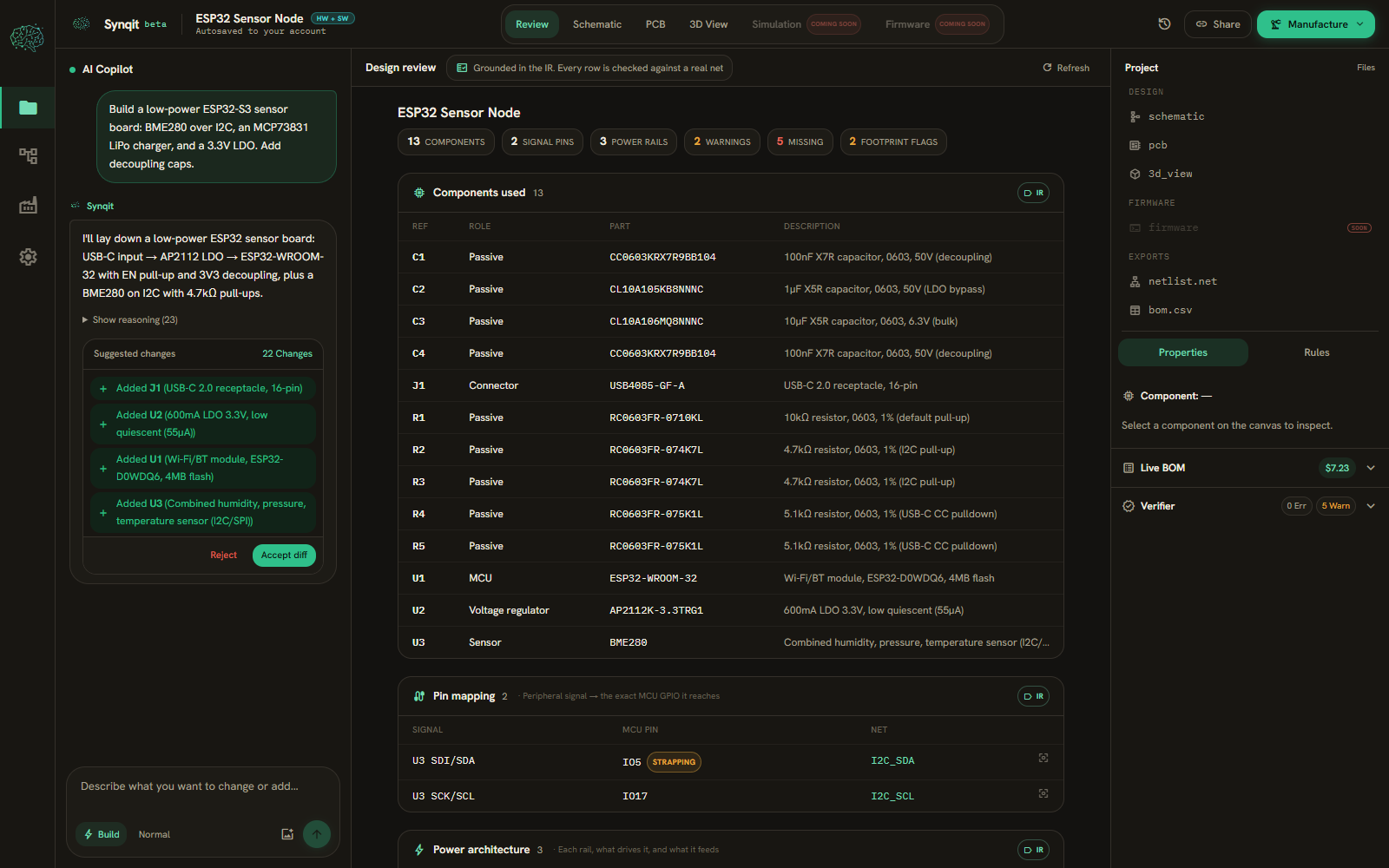
AI that checks the work, not just does it
Every change runs through deterministic engineering checks first: an ERC pin-type matrix that catches rail shorts and output contention, IPC-2221-cited trace-width and clearance rules, MCU pin-safety tables that flag strapping pins and 5V-into-3.3V mistakes, and KiCad's own industry DRC engine. Every finding names its rule and source — and the LLM design critic runs outside the agent loop, so the model that drafts your circuit never grades its own work.
Real parts, never hallucinated
Every component comes from a curated library with a real part number. The copilot can suggest a part, but it can never place one that does not exist. Expand the reasoning to see why each pick was made.
- check_circleCurated MPNs only
- check_circleReasoning shown per part

It places and routes the board
Force-directed placement and a built-in router lay down traces, vias, and a ground pour for an instant preview; Finalize hands the board to FreeRouting (the open-source autorouter, GPL-3.0) for the manufacturing-grade route. Drag any part to move it, press R to rotate, then re-route in a single click.

See it in 3D before you solder
Real component package models drop onto the board so you can check fit and orientation. Spin it, toggle layers, and catch mechanical issues long before the fab does.
- check_circleReal package models
- check_circleToggle copper, pads, vias

Built so the design holds up to scrutiny
No invented parts
Every component is a real MPN from a curated library. The agent literally cannot place a part that is not in the library.
89 checks on every design
Deterministic schematic, PCB, and enclosure rules catch floating pins, rail shorts, undersized regulators, and 5V-into-3.3V mistakes before anything reaches a fab.
The AI never grades its own work
Rule-based checks run first and the LLM design critic runs outside the agent loop — the model that drafts your circuit is never the one that approves it.
Every change is revertable
Each turn and edit is saved as a commit, so you can review the design like code and roll back any change you do not want.
Field reports
It built the schematic with real components, a proper LDO, a reverse-polarity diode, and decoupling caps with actual specs, plus a live BOM and a DRC verifier with real error counts. Genuinely impressed for a beta.
The clarifying questions before generating anything felt really thoughtful. That is the part that convinced me it was not just a generic AI wrapper.
Quotes from real beta testers, shown anonymously.
Tell Synqit what you are building, in plain English.
Every change is drafted from real parts, then run through 78 engineering checks. Findings name their rule; you accept or reject each diff.
Export a full KiCad project (schematic, board, netlist), RS-274X Gerbers with Excellon drill and a pick-and-place file, the BOM, plus STEP and IDF for mechanical CAD — a clean handoff to the tools you already trust.
Build something this weekend.
Start your first project free. No credit card, free during beta.
Start building